
The Caerphilly Conundrum: Did Tactical Voting Just Expose Reform UK’s Polling Illusion?
Caerphilly: The by-election that exposed Reform UK. Progressive tactical voting suggests their national poll numbers are inflated and won't translate into seats at the General Election.
10/25/20252 min read
The Caerphilly Conundrum: Did Tactical Voting Just Expose Reform UK’s Polling Illusion?
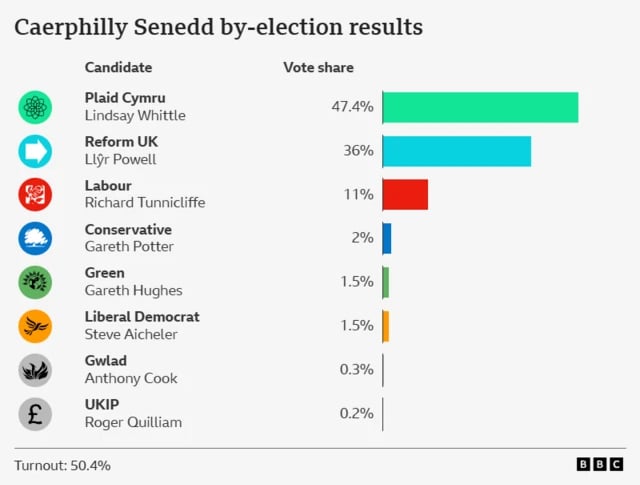
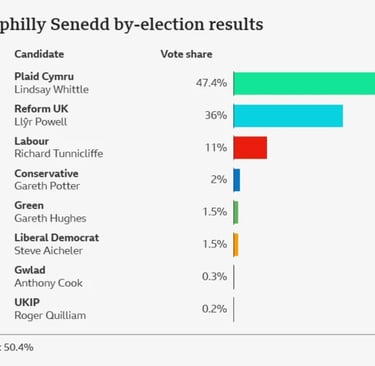
The political landscape in Wales, and indeed across the UK, shifted subtly but significantly with the result of the Caerphilly by-election. While the narrative focused on Plaid Cymru’s victory, a deeper look at the numbers suggests the true story isn’t about a sudden surge in Plaid support, but rather a chilling realization for one party in particular: Reform UK.
This result appears to be a stark demonstration of disciplined, progressive tactical voting, executed with one goal in mind: to prevent Reform UK from gaining a foothold in the Welsh valleys.
The Great Progressive Alliance of Caerphilly
For Plaid Cymru to seize the seat, the math required a significant influx of votes from outside its core base. The data strongly suggests this came from voters who traditionally back Labour, the Liberal Democrats, and the Green Party.
In a first-past-the-post system, when a party is perceived as having no realistic chance of winning—or worse, risking a victory for the party they most oppose—their supporters often hold their nose and back the strongest challenger. In Caerphilly, that challenger was Plaid.
The progressive electorate seemingly coalesced around the strongest local alternative to the incumbent Labour and the emerging threat of Reform. This was not necessarily an enthusiastic endorsement of Plaid's policy platform; it was a pragmatic, almost defensive move to consolidate the anti-Reform vote. For many, the choice was simple: secure the non-Conservative/non-Reform result, whatever the cost to party loyalty.
The Polling Paradox
This by-election result holds enormous implications for the upcoming Westminster general election, especially when viewed against the recent sensational opinion polls. Prior to the vote, several national polls had suggested that Reform UK was either level with or, in some cases, slightly ahead of the Plaid. These polls caused shockwaves, suggesting Reform was successfully capitalizing on widespread anti-establishment sentiment and discontent with the government.
However, national polls track stated preference. They measure a theoretical outcome where voters are unconstrained by local realities or the fear of a specific negative outcome. They tell us how people feel, but not always how they vote when faced with a real ballot box decision.
The Caerphilly by-election provides the missing variable: tactical voting.
The Westminster Warning
If a voter, when asked in a poll, names Reform as their preferred party, the pollster logs a vote for Reform. But when that same voter enters the voting booth in a marginal seat and realizes their Reform vote might help elect a Labour, Conservative, or Plaid candidate they find even less palatable, the dynamic changes entirely.
The progressive electorate in Caerphilly demonstrated a clear-eyed political maturity, prioritizing the defeat of the perceived threat (Reform) over loyalty to their own smaller parties.
This suggests that Reform UK may be enjoying a major polling illusion. Their high standing in national polls might be inflated by voters who are expressing dissatisfaction rather than commitment. When the general election arrives, and voters are forced to confront the binary choice of their local contest, these protest votes could evaporate.
The Caerphilly result is not merely a Welsh curiosity; it's a stark warning to Reform's national campaign. The party is fighting not just against entrenched incumbents, but against a motivated progressive electorate willing to sacrifice its own preferences for the sake of tactical pragmatism. If this pattern of progressive consolidation is repeated across key marginals in England and Wales, Reform's strong poll numbers could crumble into electoral disappointment.